Author: Fitzgerald Subaru Rockville Team
Driving a Subaru around Montgomery County means navigating a mix of hot, humid summers, unpredictable winter weather, and the daily stop-and-go commute along Interstate 270. At Fitzgerald Subaru Rockville, we understand exactly what it takes to keep your vehicle performing safely and efficiently in these Mid-Atlantic conditions. Whether you are commuting from Bethesda, tackling family errands in Silver Spring, or heading out for a weekend hike near Olney, our team has spent years learning how regional driving patterns impact your car's longevity.
This guide breaks down your Subaru's recommended maintenance schedule with our local community in mind. Instead of just pointing to a generic manual, we want to explain how timely care—adapted for the realities of navigating routes like Maryland Route 355—keeps your trusted vehicle running smoothly. By staying ahead of these routine service milestones, you can ensure your Subaru continues to deliver the legendary safety, all-weather capability, and reliable companionship you count on for years to come.
Why Should You Follow a Maintenance Schedule for Your Subaru?
Sticking to your vehicle’s recommended service intervals is the most effective way to protect your investment and keep your Subaru running safely for years to come. What this means for Rockville drivers is that routine care directly combats our specific Mid-Atlantic weather and traffic challenges. For instance, the heavy spring pollen we see around Montgomery County can quickly clog engine air filters, while hot, humid summers put extra thermal stress on belts and hoses. If you're navigating daily stop-and-go congestion on Interstate 270 or running errands down Rockville Pike, that constant accelerating and braking accelerates wear. Following the book—like inspecting your Continuously Variable Transmission (CVT) fluid every 30,000 miles—prevents these localized stresses from turning into major repairs down the road.
Ultimately, staying ahead of maintenance preserves your fuel efficiency and ensures your vehicle operates exactly as designed. Because models like the Subaru Forester and Outback rely on Symmetrical All-Wheel Drive, keeping your tires rotated and suspension aligned ensures the drivetrain distributes power evenly across all four wheels. That translates directly into confidence when roads get slick with winter rain. Proactive care delivers genuine peace of mind, whether you are loading up the cargo area for a family outing at Cabin John Park or just handling the morning commute into Bethesda. For a deeper dive into how consistent upkeep impacts long-term ownership costs and reliability, automotive review sites like Edmunds offer excellent independent research.
How Does Subaru’s Service Reminder System Work?
Subaru vehicles use integrated dashboard alerts to notify you when routine upkeep is due, typically functioning as either a straightforward time and mileage counter or a dynamic, usage-aware calculator. What this means for local drivers is that your vehicle actively helps take the guesswork out of maintenance, ensuring your engine stays reliable for the daily commute. While a traditional system simply tracks the distance driven since your last reset, many newer models—such as the 2027 Subaru Outback or 2026 Forester—can factor in driving behaviors like engine operating hours and trip lengths to estimate service timing. Whether your Subaru relies on a fixed schedule or a flexible usage formula, both methods are designed to protect your vehicle and keep it performing at its best.
When a maintenance milestone approaches, you will generally notice a visual prompt on your instrument cluster. Depending on your specific model, year, and trim configuration, this might display as a glowing wrench icon, a digital text reminder, or a descending oil-life percentage. Keep in mind that frequent short trips to Rockville Town Center, heavy stop-and-go commuting on I-270, or hauling gear for a weekend getaway all demand more from your engine. Because extreme temperature swings across Bethesda, Silver Spring, Columbia, and Olney also impact fluid longevity, these driving conditions can accelerate how often service is needed. Since exact alert behaviors vary across the lineup, always consult your owner’s manual as the definitive guide to understanding your Subaru’s specific notification system.
What Does the Primary Service Reminder Mean?
When that maintenance alert chimes on your Subaru dashboard, it’s essentially your vehicle’s way of tapping you on the shoulder to say a scheduled checkup is approaching. If your routine involves navigating stop-and-go traffic on Interstate 270 or running errands down busy Rockville Pike, your vehicle tracks those real-world conditions alongside your mileage. Because the exact interface varies across the lineup—from a 2026 Crosstrek to a 2027 Ascent—this alert might appear as a straightforward illuminated icon or a full text prompt. What this means for Rockville drivers is that you receive a timely, customized heads-up before minor wear turns into a disruption, giving you a chance to consult your owner's manual or touchscreen display for the exact requirements.
Primary reminder: This functions as a broad signal to check your factory maintenance schedule and book an appointment. Instead of bombarding you with a long list of technical tasks while you are trying to focus on Montgomery County traffic, it simply alerts you that general care is due.
Additional details (if shown): Depending on your model, the dashboard might also reveal a dedicated maintenance menu, a percentage countdown, or specific symbols that provide more context. You can use these extra clues, paired with your owner’s manual, to ensure your Subaru is perfectly prepped for everything from unpredictable winter weather to a family weekend out at Cabin John Park.
What Do Additional Service Indicators Mean?
What this means for Rockville drivers is that your dashboard isn't just flashing a generic warning—it's often providing a specific checklist to keep your Subaru reliable for your daily routine. Beyond the primary wrench icon or maintenance light, many vehicles display extra symbols or menu prompts to pinpoint exactly which system needs attention. For example, the multi-function display in a 2026 Subaru Outback might alert you to a specific filter or fluid requirement rather than just a basic oil change. Because the exact wording and icons vary across the lineup, your owner’s manual or center touchscreen is always the best place to translate these alerts. When these secondary reminders pop up, they generally point to one of the following routine needs.
- Tire rotation: Moving your tires to different wheel positions promotes even tread wear, which is incredibly important for Subaru’s Symmetrical All-Wheel Drive. To prevent undue stress on the drivetrain, all four tires typically need to stay within 2/32 of an inch in tread depth. Frequent braking in the tight corners around Rockville Town Center or steady highway commuting up Interstate 270 (I-270) will influence how quickly that rubber wears down.
- Engine and cabin air filters: A clean engine filter ensures your Boxer engine breathes easily, while the cabin filter traps dust, allergens, and exhaust fumes before they reach you. Navigating heavy traffic on Maryland Route 355 (Rockville Pike) or dealing with dense spring pollen near Rock Creek Park can clog these filters faster than you might expect.
- Transmission fluid: Some indicators track the health of your transmission fluid. Here's a quick comparison: creeping through stop-and-go traffic on Shady Grove Road generates significantly more transmission heat and fluid degradation than cruising steadily at highway speeds. Clean Lineartronic® CVT fluid keeps those gear transitions smooth over time.
- Spark plugs and valve clearance check (when applicable): Usually triggered around the 60,000-mile mark, fresh spark plugs ensure efficient combustion and reliable starts on cold winter mornings. Depending on your engine configuration, a valve clearance inspection might also be recommended at higher mileage intervals to keep the valvetrain running quietly.
- Engine coolant: Subaru Super Coolant protects the engine from freezing in the winter and boiling over during hot Mid-Atlantic summers. While it has a famously long initial lifespan—typically lasting up to 137,500 miles or 11 years—your dashboard will eventually remind you when it’s time for a flush to maintain proper temperature regulation.
- Rear differential fluid (AWD/4WD, if equipped): Because your Subaru is constantly routing power to all four wheels, the differential gear oil works overtime. Commuting through heavy rain, navigating winter slush in Montgomery County, or tackling uneven dirt roads places extra demand on these rear drivetrain components, making fresh fluid essential for reliable traction.
- Brake fluid: Brake fluid naturally absorbs moisture from the air over time, which lowers its boiling point and can lead to a spongy pedal feel. A dashboard reminder for brake service usually aligns with the standard 30,000-mile replacement interval, ensuring you always have confident stopping power when someone suddenly hits their brakes in front of you near Westfield Montgomery Mall.
What is a Typical Subaru Service Schedule for Rockville Drivers?
While your specific owner's manual and any on-board alerts (if equipped) remain the ultimate source of truth, having a general maintenance roadmap helps you anticipate when your Subaru will need attention. What this means for Rockville drivers is that you can schedule appointments and plan for upkeep long before a dashboard notification appears. For instance, if your daily routine involves crawling through heavy commute traffic on Maryland Route 355 (Rockville Pike) or making frequent, short trips to Fallsgrove Village Center, your vehicle experiences different wear than it would during steady, uninterrupted highway cruising. Because most modern Subaru BOXER engines typically require full synthetic 0W-20 oil and adhere to a standard 6-month or 6,000-mile maintenance cadence, understanding this rhythm ensures your Outback or Crosstrek stays reliable through Montgomery County's drastic seasonal temperature shifts. The mileage outline below serves strictly as a practical planning aid, designed to complement official manufacturer guidelines so you are always ready for the next adventure.
What Services Are Needed in the First 30,000 Miles?
During the first 30,000 miles on the odometer, your Subaru primarily needs fundamental care like regular oil changes, tire rotations, and fresh cabin or engine air filters. Staying on top of these early basics is exactly what preserves the long-term dependability you expect from models like the gas-powered Subaru Forester or Crosstrek. If your daily routine involves inching through rush hour on Maryland Route 355 or taking short, stop-and-go trips for errands around Fallsgrove Village Center, this type of driving can actually accelerate your maintenance timeline compared to steady highway cruising.
- Routine oil service: For many modern Subaru vehicles, a synthetic oil change is typically recommended somewhere around the 6,000-mile or six-month mark under normal use. Keeping fresh oil circulating is essential for lubricating internal engine components and preventing premature friction wear.
- Tire rotations: It's common practice to rotate your tires on a repeating schedule—often paired right alongside your oil service. Because standard Symmetrical All-Wheel Drive requires tires to have closely matching tread depths for optimal grip, skipping this simple step can actually strain your drivetrain over time.
- Air and cabin filters: Fresh filters keep your engine breathing easily and your interior free of allergens, with replacements generally falling somewhere in the 15,000- to 30,000-mile window. However, heavy spring pollen blowing over from Rock Creek Park or construction dust around Bethesda and Silver Spring can clog these up much faster, so it's always smart to have them inspected periodically.
What Maintenance Should Be Done Between 30,000 and 60,000 Miles?
Between 30,000 and 60,000 miles, maintenance typically transitions from basic oil changes to more comprehensive fluid exchanges and deeper component inspections. During this window, evaluating transmission health and replacing aging brake fluid often become top priorities. Because every Subaru—whether it's an efficient Impreza sedan commuting to Montgomery College or a rugged Forester Wilderness built for weekend trails—has a unique powertrain and driving profile, it is always best to check your owner's manual and any in-vehicle alerts to confirm the exact timing for your specific model.
Transmission fluid service is often recommended around the 30,000 to 60,000-mile mark, especially if your daily routine involves heavy traffic or frequent short trips. If you regularly navigate the stop-and-go congestion of Interstate 270 (I-270) or make quick supply runs down Rockville Pike (MD-355) to Rockville Town Center, that constant speed fluctuation generates extra heat in your drivetrain. Refreshing the fluid removes degraded oil and microscopic debris. What this means for Rockville drivers is simple: proactive fluid changes protect the intricate components of your Subaru's Continuously Variable Transmission (CVT), supporting smoother acceleration and extending the lifespan of one of the vehicle’s most vital systems.
In addition to transmission care, brake fluid replacement is widely recommended on a time-based cadence—often every two to three years—because the fluid naturally absorbs moisture from the air regardless of how far you drive. Think of it this way: trying to stop safely with water-logged brake fluid is like trying to soak up a spill with a sponge that is already wet; the old fluid simply cannot compress and transfer stopping power effectively. That makes regular brake system and tire tread inspections increasingly crucial as the miles add up. Whether you are braking for a sudden red light on Wootton Parkway in the rain or loading up an Outback for a family afternoon at Cabin John Park, fresh fluid and healthy tires keep your handling predictable. To see how closely consistent fluid maintenance ties to long-term vehicle reliability and safety scores, you can always explore the extensive owner feedback and testing data on Consumer Reports.
What Major Services are Required Approaching 100,000 Miles?
When your Subaru approaches the six-figure mileage mark, you can commonly expect three larger maintenance items to come into focus: spark plug replacement, cooling system service, and occasionally a timing belt swap. Because driving habits vary greatly—whether you are mostly making short grocery runs to King Farm Village Center or logging heavy commute miles on I-270—this 100,000-mile benchmark is not a rigid, universal requirement for every single vehicle. It is simply a common window for milestone upkeep. Always refer to your owner's manual to confirm the exact intervals recommended for your specific model.
Spark plugs and engine coolant: Installing fresh spark plugs is vital for maintaining fuel efficiency and smooth, reliable engine starts. Here is exactly why this matters: over tens of thousands of combustion cycles, a spark plug's electrode gradually wears down and widens the gap, which forces the ignition system to work harder and can reduce efficiency in models like the gas-powered 2026 Subaru Crosstrek. Alongside ignition care, periodic coolant flushes are highly recommended. Refreshing this fluid removes degraded anti-freeze and replenishes essential anti-corrosion additives. For Rockville drivers, a healthy cooling system is critical for preventing your engine from overheating during those hot, humid Maryland summers when afternoon traffic slows to a crawl near Montgomery College.
Timing components and long-term value: Finally, you will want to verify whether your specific engine utilizes a timing belt or a timing chain. Some older Subaru engine designs feature a heavy-duty timing belt that requires a scheduled replacement to prevent catastrophic internal damage. Conversely, a large portion of modern Subaru vehicles, such as the 2027 Subaru Ascent, rely on durable metallic timing chains that do not typically require routine replacement at a set mileage. Staying on top of whichever milestone services apply to your car ensures that your engine continues running safely. Maintaining a documented service history for these major jobs is also one of the best ways to protect your investment; you can reference Kelley Blue Book to see how diligent, on-time maintenance directly supports long-term vehicle resale value.
Why is Local Expertise Important for Servicing Your Subaru?
When you maintain your vehicle, having a team that intimately understands the Mid-Atlantic climate makes a noticeable difference. What this means for Rockville drivers is that our technicians know exactly how regional variables impact your car, from intense summer humidity to freezing, salt-covered winter roads. For example, if you routinely commute via I-270 or tackle the heavy stop-and-go traffic along Rockville Pike, your brake pads and CVT (Continuously Variable Transmission) fluid endure different thermal stress than they would in a low-traffic rural environment. We routinely inspect Subaru Symmetrical All-Wheel Drive undercarriage components for early signs of winter salt corrosion, and we typically recommend cabin air filter replacements every 12,000 miles. Sticking to that 12k-mile filter interval matters specifically here, because it prevents our heavy Maryland spring pollen from choking your A/C system just as summer temperatures spike.
Understanding the local environment is only half the equation; you'll also want to stay informed on broader automotive standards. Drivers looking to deepen their safety knowledge can easily consult the National Highway Traffic Safety Administration (NHTSA) for verified safety information, crash ratings, and federal guidelines. Pairing this independent, national data with official Subaru owner resources ensures you have the precise maintenance schedules for your Crosstrek or Outback. By combining factory engineering standards with a local technician's deep knowledge of Montgomery County roads, your vehicle stays fully prepared for everything from daily Metro station commutes to weekend trips out to Cabin John Park.
Frequently Asked Questions (FAQs)
How does Fitzgerald Subaru Rockville manage service appointment wait times?
Whether you are commuting down I-270 or running errands near Rockville Town Center, Fitzgerald Subaru Rockville respects your schedule through a commitment to efficiency and transparency. Our team proactively manages our service bays and provides comfortable amenities, including complimentary car washes, to make your visit seamless.
How does Fitzgerald Subaru Rockville handle appointment scheduling?
Our staff handles scheduling with a focus on customer satisfaction, ensuring you can easily plan maintenance around your drives to Cabin John Park or Montgomery College. Fitzgerald Subaru Rockville is part of the largest employee-owned dealership group in the U.S., which means our team is personally invested in communicating clearly and respectfully to accommodate your needs.
What are the busiest times for service appointments?
Morning drop-offs before the rush on Rockville Pike tend to be popular, but Fitzgerald Subaru Rockville remains dedicated to providing an exceptional experience regardless of when you visit. We offer virtual showrooms and comprehensive service amenities so you can comfortably explore our inventory or relax while we maintain your vehicle.
Can I expect my service to be completed within the promised timeframe?
Yes, Fitzgerald Subaru Rockville builds lasting relationships by maintaining strict communication regarding your vehicle's progress. Having proudly served the community since 1966, we take pride in delivering on our promises so you can confidently get back to navigating Maryland Route 355 or taking weekend trips to Westfield Montgomery Mall.
What is the pricing philosophy at Fitzgerald Subaru Rockville?
Fitzgerald Subaru Rockville proudly uses a no-haggle "FitzWay Price" philosophy to guarantee a transparent, stress-free experience for every customer. As a 100% employee-owned dealership, we provide clear, upfront options whether you are exploring new models or utilizing our College Grad and Military programs.
How does Fitzgerald Subaru Rockville support the local environment and community?
Beyond operating an eco-friendly certified facility, Fitzgerald Subaru Rockville actively supports local schools, charities, and organizations like the Humane Rescue Alliance and Children's National Hospital. Our team believes in making a positive impact on the Rockville area, proving our mission extends far beyond just selling cars.
About Fitzgerald Subaru Rockville
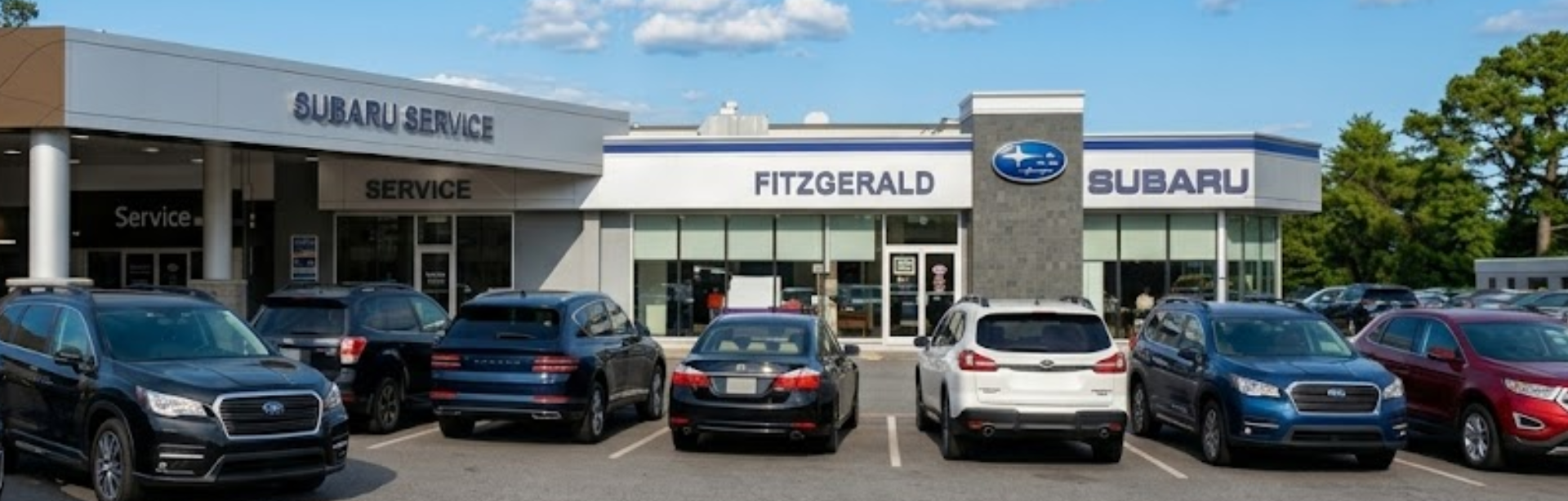
At Fitzgerald Subaru Rockville, we are proud to serve drivers across Rockville, North Bethesda, and Montgomery County, Maryland, with automotive solutions grounded in transparent expertise. Established on Rockville Pike as part of the Fitzgerald auto family founded in 1966, our 100% employee-owned dealership brings nearly six decades of industry authority and localized experience to every guest. Honored with prestigious distinctions like the Subaru Love Promise Customer & Community Commitment Award and recognized as a Certified Subaru Eco-Friendly Retailer, our expertise is backed by strict ISO 9001 and ISO 14001 quality and environmental certifications. Beyond our showroom, our team remains deeply invested in our community through vital initiatives like our Child Safety Seat Program—which has inspected over 55,000 car seats—and active partnerships with local animal welfare organizations and schools. Whether you are shopping for a new vehicle or seeking factory-certified service, you can trust our dedicated employee-owners to deliver complete transparency, technical excellence, and the dependable FitzWay standard you deserve.
Related Articles:
Finding the Top Subaru Dealer in Rockville, MD: A Comprehensive Guide